tag: Pure-Data

Livecode Festival #2 - Visualists Meetup - 1st September 2018

On Saturday 1st September I’m organising a meetup for visualists as part of Livecode Festival #2 at Access Space in Sheffield:

Livecode Festival #2 - Visualists Meetup - 1st September 2018

A session for live coding visualists (at any level) lead by Antonio Roberts (aka hellocatfood), to talk about their tools and how they perform, with focus on Algorave visuals.

A core part of the session will be discussion around key questions for live code visualists; how do you pace yourself in a performance? Should we aim to build up slowly or go straight in with loud visuals? How much can you truly respond to the music? Is it important to show the code, and how does it fit with the musician’s projection?

Five Days of Pure Data - Live Coding

In the years that I’ve been creating things in Pure Data I have amassed quite a collection of unfinished and messy patches. Over the last few days I have been releasing a few of these patches and techniques that I implement when programming in Pure Data.

Live Coding

The last tutorial isn’t that much about actually programming with Pure Data and is more about performing with it. More specifically, live coding. Live coding takes programming to a performative level. There’s been a lot of writing recently about Live Coding so take a look around. I’ve been programming live visuals for Pure Data since 2014 (a lot happened that year). It’s not without it’s problems, some of which I written about in the past.


Five Days of Pure Data - Stop Motion

In the years that I’ve been creating things in Pure Data I have amassed quite a collection of unfinished and messy patches. Over the next few days I’ll be releasing a few of these patches and techniques that I implement when programming in Pure Data.

Stop Motion

It was at the Co-Position meeting of the Libre Graphics Research Unit in 2012 that I first encountered Toonloop. It’s creator, Alexandre Quessy, gave a live performance using lights, Lego pieces and other objects. I was really quite in awe of how stop-motion was used to create quite an enjoyable performance.


Five Days of Pure Data - Infinite Scrolling

In the years that I’ve been creating things in Pure Data I have amassed quite a collection of unfinished and messy patches. Over the next few days I’ll be releasing a few of these patches and techniques that I implement when programming in Pure Data.

Infinite Scrolling

For a performance at ChipFest 10 in 2014 I wanted to recreate the look of a scrolling video game but within Pure Data. Sure, I could have just used a console emulator or recorded a clip and used that but doing it all within Pure Data allows me to have some more flexibility with how I perform. Here’s what I made:


Five Days of Pure Data - Randomise Text

In the years that I’ve been creating things in Pure Data I have amassed quite a collection of unfinished and messy patches. Over the next few days I’ll be releasing a few of these patches and techniques that I implement when programming in Pure Data.

Randomise Text

In the early 2010s I had quite an interest in zines. I had co-organised the Birmingham Zine Festival and was quite regularly reading this. As a result of this in 2011 I started collaborating with a friend, Rebecca Evans, on a collaborative zine. The concept is that we would interpret each others’ way of working using our regularly used tools. Rebecca specialises in textiles and has quite a skill at crocheting, amongst other things. I, on the other hand, can barely operate a sewing machine and feel much more at home using a soldering iron or computer.


Five Days of Pure Data - Image to Signal

In the years that I’ve been creating things in Pure Data I have amassed quite a collection of unfinished and messy patches. Over the next few days I’ll be releasing a few of these patches and techniques that I implement when programming in Pure Data.

Image to Signal

If you’re into experimental ways of creating visuals and happened to be on the internet around 2013 you have have been sent information about software called PixiVisor. The software, developed by Alexander Zoloto, allows one to transmit an image via an audio signal to another device which decodes it and displays it as an image. In this way you can then apply audio effects to the signal and make some pretty cool visuals. I never tried it myself but was quite impressed by what I saw.


Blood Sport - Live at Cafe Oto video

On 5th May Blood Sport released their latest LP, Live at Cafe Oto which, as the name suggests, is a live recording of a 40 minute set they did as part of their residency at Cafe Oto.

To coincide with its release Blood Sport asked me to create a one-take video. The video below shows track two from the LP, Melts Into.

The full 40 minute video will be made available at a later date. In the meantime you should buy their LP. They will be performing alongside Heavy Lifting at Supersonic Festival on June 16th.


Pure Data for Beginners workshop at #ArtistsCompute2016, 10th September

On 10th September I’ll be delivering a Pure Data for Beginners workshop as part of #ArtistsCompute2016 in Coventry.

Pure Data Patching Circle

Having recognised that computers have changed society beyond measure #ArtistsCompute2016 is dedicated to mapping, presenting, probing and escalating this impact.

The festival, which is built around a large group exhibition of the same name, features many educational, participatory and enjoyable events including workshops, talks, screenings, performances and parties.


Coding Camo Workshop - 15th - 17th August

The Office for Art, Design and Technology (led by Ryan Hughes) is delivering its Camouflage Season as a part of Leamington Spa Art Gallery and Museum’s exhibition, Concealment and Deception and as a part of Leamington Camouflage Festival. For its Coding Camo Workshop on the 17th August I’ll be delivering a Pure Data workshop at the headquarters of Office for Art, Design and Technology at Eaton House, Coventry.

codingcamo

This workshop will teach basic computer code using Processing, Pure Data and Live Code Lab and will result in a collaborative performance. The workshop will be led by Ryan Hughes and participants will benefit from 2 days working with established visiting practitioners, Antonio Roberts and Ashley James Brown. The final day of the workshop will focus on collaboratively composing a new work for performance which explores what camouflage might look like in the age of big data, ubiquitous wi-fi and so called smart devices.


Pure Data Patching Circles at BOM

From 16th March to 27th April I ran a four part Pure Data Patching Circle at Birmingham Open Media. It was originally intended to be an informal gathering of Pure Data and “creative coding” enthusiasts but quickly it turned into a course in using Pure Data. Here’s some of what I learnt from running it.

Patching Circle #1

This was an almost exact replication of the beginner’s Pure Data workshops that I’ve done in the past at places such as GLI.TC/H 2012, Vivid Projects and Flip Festival. I first introduced some of the projects that I have done and then dove straight into things like installing the software on different platforms.


Creative Code #1: Pure Data Patching Circle

On various dates in March and April 2015 I’ll be running a Pure Data Patch Circle as part of Birmingham Open Media’s Creative Code series.

pdpatchingcircle

A new ‘Patching Circle’ on creative code designed and run by artists, for artists. A Patching Circle is an informal gathering of anyone who is interested in patching languages such as Pure Data, Max/MSP, vvvv, and Quartz Composer.

As well as covering the basics of Pure Data, we’ll also offer peer-to-peer support for more experienced users and help with specific projects.


Gifs in Pure Data

Every so often on my travels across the information superhighway I come across a Pure Data user asking if animated gif files can be read in Pure Data. Technically speaking they have always been able to be read in Pure Data, but not always in a way that a user usually wants. Using the [pix_image] object a user can read almost any image file format. On Linux this is dependent on ImageMagick, so whatever it can read can (theorectically) be displayed in Pure Data/GEM. The problem arises because [pix_image] doesn’t display animated gifs as animations, only the first frame.


Pixel Player

Back in June 2014 I wrote how that in 2013, after visiting The Cyborg Foundation in Barcelona, I became interested in exploring sonification. My experients at that stage culminated in the production of the Pixel Waves Pure Data patch, which allows the sonification of images based on the colour/RGB values of individual ppixels.

I spent the following months building and refining an update to the Pixel Waves software, with a focus on allowing multiple images to be played simultaneously. In a way, I wanted to create a sequencer but for images. After many months I’m happy to formally announce the release of the Pixel Player.


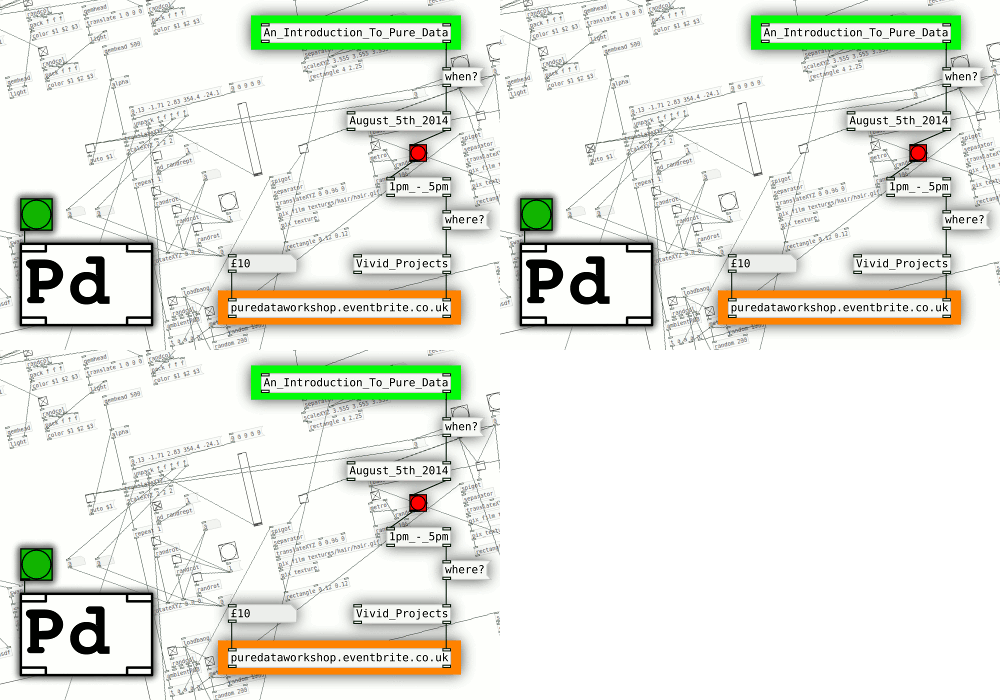
An Introduction to Pure Data - 5th August

On August 5th from 13:00-17:00 I’ll be running a Pure Data workshop at Vivid Projects.

puredataworkshop

Pure Data (aka Pd) is an open source a Visual Programming Language, similar to the likes of vvvv and Max/MSP. Pd enables musicians, visual artists, performers, researchers, and developers to create software graphically, without writing lines of code. Pd has seen various implementations including live visuals (VJing), electronic music and even as an embedded library on websites, games or a Raspberry Pi.


Thoughts on live coding visuals in Pure Data

I took part in Algorave in Gateshead on 26th April. Apart from being incredibly awesome it was my first time live coding - or rather live patching - visuals in Pure Data from scratch. I emphasise from scratch because nearly all of my performances involve me modifying patches, but never starting with a completely blank canvas. I also occasionally used the HSS3jb as a texture for objects, but never on its own. It’s also great for when crashes occur, which is/was often ;-). Here’s a few sampels of my visuals. Videos by Mariam Rezaei:


NeonPlastic

I’m happy to announce the release of NeonPlastic, a generative Pure Data artware piece by myself (visuals) and Joe Newlin (audio), inspired by Neoplasticism and all things boxy.

The above video acts only as a preview. To experience this piece in all its hdmegaawesomeness grab the code, open Pure Data, get yourself a cup of tea and press the big red button!


Pure Data File Killer

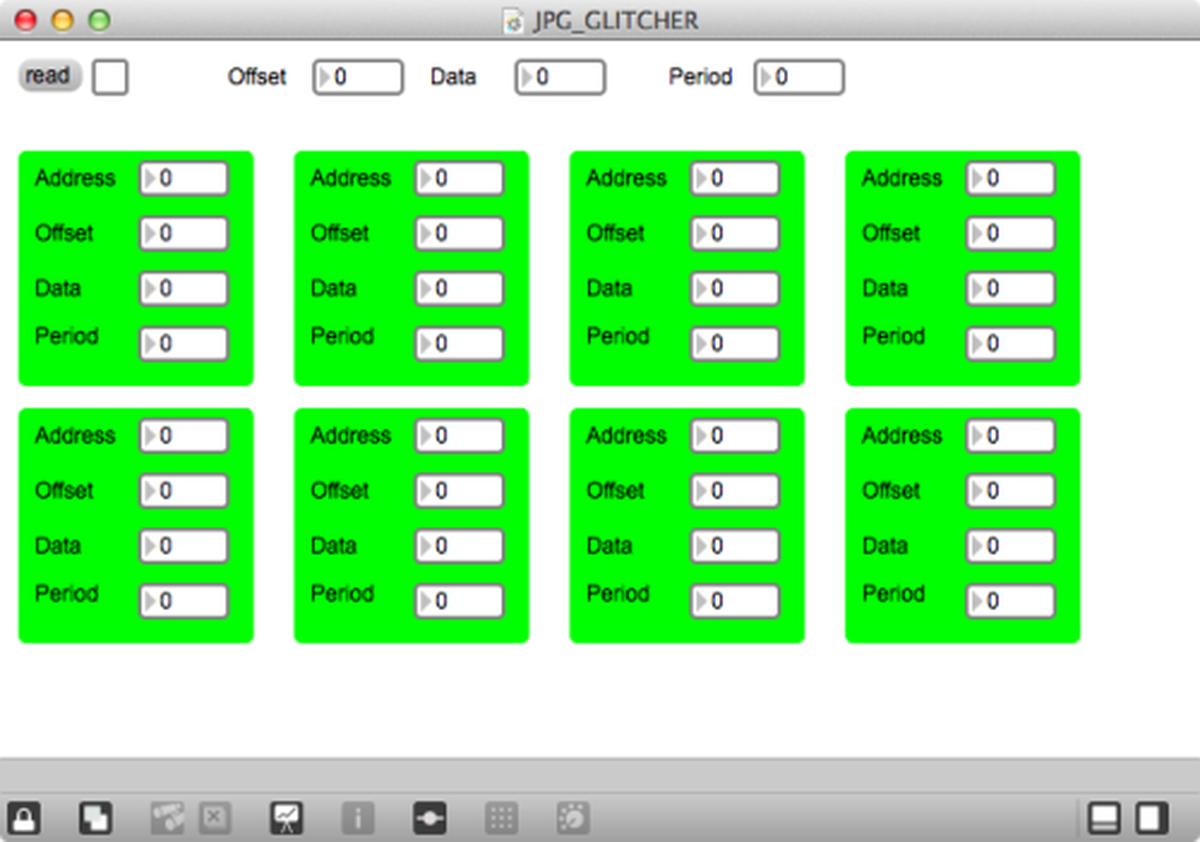
On one of my frequent journeys on the information superhighway I stumbled across Little-Scale’s Mass JPG Killer. This handy little patch allows a user to load any binary file and “glitch” it by overwriting some of the original data with a repeating pattern of user-defined data.

Mass JPG Killer by Little-Scale

The only problem (for me and people like me) is that I don’t have Max/MSP and can’t install it on Linux, meaning I’ve never actually used it!


Multimedia Programming with Pure Data

A new book by Bryan Chung, Multimedia Programming with Pure Data was recently published by Packt Publishing.

Multimedia Programming with Pure Data

Multimedia Programming with Pure Data

Multimedia Programming with Pure Data

Despite it being a big part of Pure Data Extended, GEM - and making visuals in PD - doesn’t get as much attention as audio processing. Whereas sound-makers have resources such as Loadbang and excellent tutorials from Obiwannabe, visual artists have little access to such a comprehensive resource, which can be a bit off-putting for new users. With that in mind I was more than happy to be a reviewer for this book that focuses almost entirely on GEM and making visuals in PD.


Pure Data Play

Thank you to everyone that attended the Pure Data Play workshop on 2nd November as part of Flip Festival. In the space of two hours the participants went from knowing nothing about Pure Data to manipulating 3D objects on screen, playing videos and webcam streams and controlling their videos using user-defined keyboard shortcuts. Some images of the patches:

Pure Data Play - Alex Jolliffe
Patch by Alex Jolliffe
Pure Data Play - Eliza Marcu
Patch by Eliza Marcu
Pure Data Play - Jamie Boulton
Patch by Jamie Boulton


Pure Data Play, Friday 2nd November

On Friday 2nd November from 12pm I’ll be running a Pure Data workshop as part of Flip Festival at Lighthouse Media Centre in Wolverhampton.

pd

Pure Data is a dataflow programming language that is utilised for a wide variety of purposes including making generative electronic music, creating glitch visuals, interactive live performance and VJing (Video Jockeying). I’ll guide participants through the basics of Pure Data - including general usage, playing and manipulating videos and creating generative visuals that respond to different inputs. No experience of Pure Data is necessary, only a laptop and a willingness to experiment and learn!


Create jpgs in Pure Data

For Some of My Favourite Songs I utilised Pure Data Extended (I’m using a beta version) to read the audio files and then save them as images. Pure Data is usually used for the production of music and/or generative live visuals, so to using it to produce jpg images from almost nothing, or random data input is quite new to me!

In search of a jpg header

The most important part of this process is knowing how to construct and apply a jpg header to data. Wikipedia informed me that all jpg images begin with FF D8. I thought that all I would need to do is use a hex editor, such as Ghex or Bless Hex Editor, to add those byte values to a file.


Text on multiple lines in Pure Data

For my set for From Digbeth With Hammers at BOYD 8 I was required to display their logo on screen. This sounds like it should be a relatively easy task, but their logo consisting of four lines of text presented some interest problems.

From Digbeth With Hammers

In Pure Data there’s three objects you can use to display text on-screen: [text2d], [text3d] and [textextruded]. They have different ways of receiving text input, which I’ll get onto later, but one of the common methods that I often utilise in this scenario is by using a symbol box. In addition to receiving symbols Symbol boxes can be used to input text by just clicking on the box and typing text. Hitting Enter sends that text to its outlet. This presented a slight problem.


From Digbeth With Hammers at BOYD 8

Since November 2011 I’ve been providing visuals for First Fold Records’ monthly Bring Out Your Dead (BOYD) events. This sees me working with the headline acts to create visuals tailored to their performance. I often do a recording of the sets, which you can see on my YouTube channel.

For BOYD 8 I did visuals for local band From Digbeth With Hammers. The band said they wanted any visuals that included “bricks and concrete and things that look like they’ve been hit with massive hammers.” So, I got them lots of videos of explosions, demolition sites and cranes ;-) Here’s a sample of the visuals that I did set to the “Collage” track available from their website


Feedback Loops in Pure Data

Recently I’ve been making a few video loops for Dreambait Recordings to use in their shows. The videos, made using video samples and Pure Data, focus on feedback loops. For BYOB Birmingham on Friday 16th March I decided to showcase these video feedback creations. Some photos of it in action:

BYOB Birmingham

BYOB Birmingham Flatpack Festival 2012
Photo by minuek

The Pure Data patch used to make these visuals, inspired by this patch is pretty simple: Put an object on screen, take a snapshot of the screen and then apply that snapshot as a texture to another object. You can download it below


Alpha Glitch

For my performance with Freecode as part of Network Music Festival I wanted to move away from producing visuals that consisted mostly of video playback and move towards generative art. Demos of this were posted on my Flickr site, and the first performance that utilised this new approach happened on 26th January

The feedback from people online and at the performance was really positive, with a lot of people were asking how to do something similar. The patch I made for it was very messy so I (albeit slowly) remade part of the patch that achieves that effect. It’s available for download below


GLI.TC/H 2011 - This website does not supply identity information

My bumper for GLI.TC/H 2011. Download the Pure Data patch that made this and make your own!

Discuss it with others on the Pure Data forum.

.our_name/website { GLI.TC/H gli.tc/h } .theDates { Chicago_USA: Nov 4-6 2011; Amsterdam_NL: Nov 11-12 2011; Birmingham_UK: Nov 19 2011; }

I’ve also recently started making diagrams of my Pure Data patches. I hope they go some way to helping people learn Pure Data


Making Skin Cells

The making of Skin Cells was quite a long process. It started projecting my Bunnies video onto me and filming this. I then took this and ran it through the What Glitch? sgi script to create a glitched version of the video, leaving me with two versions of the video.

Skin Cells

Skin Cells

When it came to merging the two videos together I took some inspiration from Tidepool by Tabor Robak. Putting the videos on top of each other I wanted to use chromakeying to reveal parts of the video at the bottom at the same time as really oversaturating the video. For this I employed the help of Pure Data:


The face game

I’m working on a live performance that in some ways will incorporate glitch and perhaps animation. This is one step towards getting a finished performance down, but also a bit of fun.


VJing

I need to get more done on my vjing work. So far I’ve done very little of it, and even less djing. I’ve been messing around with Pure Data, Xaos and Processing in an attempt to get some live processed images, and I’m now taking a peek at Ben Neal’s Phlumx software, but what I wonder is if I need to go look at more professional software…

Here’s a sample of what I’ve done. It was for a project at university to create a video about ‘Speed’ (created in Adobe Premier).