Exactly 10 years ago the first GLI.TC/H was starting in Chicago, IL. Attending that festival was turning point in my practice and, the more a reflect on it, an important part of my personal life. Here I want to reflect on that a bit.
GLI.TC/H is an international gathering of noise & new media practitioners in Chicago from September 29 thru October 03, 2010!
GLI.TC/H features: realtime audio & video performances with artists who misuse and abuse hardware and software; run-time video screenings of corrupt data, decayed media, and destroyed files; workshops and skill-share-sessions highlighting the wrong way to use and build tools; a gallery show examining glitches as processes, systems, and objects; all in the context of ongoing dialogues that have been fostered by experimentation, research, and play. GLI.TC/H is a physical and virtual assembly which stands testament to the energy surrounding these conversations.
I was in Chicago from 5-10th December for GLI.TC/H 2112. As with the previous two years of the festival it was a really intense ~week of workshops, performances, presentations, art, pizza and copious amounts of alcohol civilised social gatherings over wine and cheese cubes.
As stated previously, I gave a presentation about AlphabeNt (coming soon!) with Daniel Purvis joining in from Australia via Skype. I’ll be writing/talking a little bit more about this in the future, but for now you can watch the presentation on the GLI.TC/H Ustream channel (from 1:20:00 onwards). I also gave a workshop in Pure Data as part of DNMw3rkstati0n::.
On Friday 7th December between 9-10pm at High Concept Labs I’ll be at GLI.TC/H in Chicago to give a short lecture on my explorations with glitch and language:
Antonio Roberts’ journey into glitches and their relationship to language started with the Dataface font-hacking project in 2010, the result of which is downloadable as a font from the Open Font Library. Using Daniel Purvis and Drew Taylor’s project AlphabeNt project as a launching point, Antonio Roberts will be discussing the relationship between computer language and human language, and how this relationship can be strengthened through mutation and curation, instead of deletion.
I’ll be taking part in the DNMw3rkstati0n:: as part of GLI.TC/H on Saturday 8th December from 10-12pm at High Concept Labs
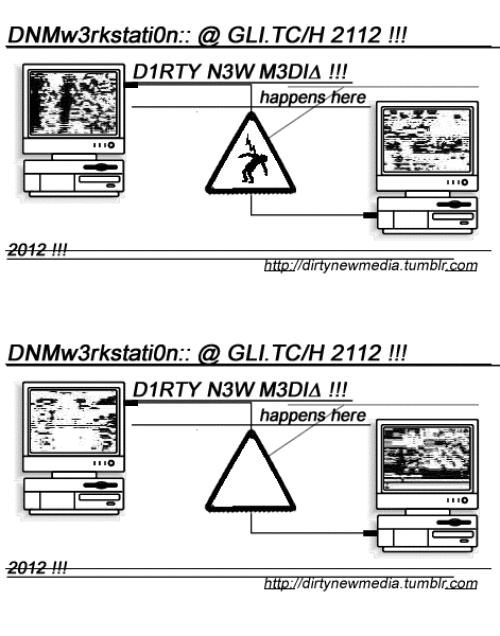
GET: dowwwn && durty IRL && online wit teh DNMw3rkstati0n:: crewww @ GLI.TC/H 2112 in Chicago! The DNMw3rkstati0n:: is an open safe space/place/work{station|shop} set aside @ GLI.TC/H for enagaging eXXXperimentz in the arts of D1RTY N3W M3DI∆!
NEXT: BYOC (Bring Your Own Computers) TO: HIGH CONCEPT LABS (1401 W. Wabansia Chicago IL, 60642) && receive tutorials on D1RTY N3W M3DI∆ aestheticonceptechniques such as:
GLI.TC/H is back for 2112 in Chicago and needs your halp! Spendyspendyspendy!
I’m not personally involved in the organisation of the festival this year, but I’ll be physically present in Chicago for the duration of the festival! More on that later
Education has always played a role in GLI.TC/H: from organized workshops, to performers informally sharing their hacked and homebrewed gear with attendees, to theory sessions over pizza.
as part of the Kickstarter we launched last year for GLI.TC/H 20111 we offered various physical media from different artists as incentives, these ranged from DVDs to VHS tapes to NES cartridges. One such incentive was conceived by Morgan Higby-Flowers and Jeff Donaldson (aka noteNdo) and curated/produced by Jeff Donaldson and myself (Nick Briz). This was a 20GB Engraved HDD with worx (and often source files) from an array of glitch artists. Because only 9 (for kickstarter supporters) of these were produced, no one (including the artists who donated their files) really got a chance to see these.
GLI.TC/H happened in Chicago, Amsterdam and Birmingham last year but I’ve only just gotten around to making this short video of the event in Birmignham, using footage captured by Pete Ashton
Enjoy!
(I had previously made an overview video for GLI.TC/H 2010)
Part of Birmingham City University’s involvement in GLI.TC/H 2011 involved me teaching Kate Pushkin, a student on the MA Digital Arts in Performance course, how to “do” glitch art, with the aim of devising a ~15 minute piece to be performed at GLI.TC/H. Given the number of tutorials and tools that are available online one would imagine this to be an easy challenge, right? Well, I only had the week prior to GLI.TC/H to do all of this. Yikes!
Shortly after GLI.TC/H hit Birmingham I did a short interview with Jonathan Melhuish for the Redbrick, Birmingham University’s newspaper.
[caption id="" align=“alignnone” width=“500” caption=“Original Photo by Jonathan Melhuish. Click to read article”][/caption]
Jonathan Melhuish: So, what is “glitch art”?
Antonio: Glitch art is making art out of analogue or digital errors. It can bemade using computers using techniques like attempting to open animage in a text editor or with physical objects, like opening up electronic toys andpoking around at its circuitry until you achieve odd and unexpectedresults.
Gregory Sporton, for supporting the event, even if he doesn’t quite get what it all is!
Lorna Hards, whose course, Methods and Models of Curatorial Practice, gave me the confidence to curate GLI.TC/H Birmingham
VIVID, for accepting the proposal for GLI.TC/H Birmingham to be part of their “The Garage Presents…” programme and for providing an amazing space to hold this event in as well as technical and programming assistance
GLI.TC/H has started and on Saturday November 19th it’ll be making its way to VIVID in Birmingham, UK! The full programme is available here, and as a PDF. Over the week I’ll be providing a bitesized overview of the upcoming events.
Realtime A/V: Jon Satrom
Jon Satrom presents a prepared desktop performance, where he uses the operating system itself as an instrument:
Bio
Satrom spends his days fixing things and making things work. He spends his evenings breaking things and searching for unique blips inherent to the systems he explores and exploits. Satrom teaches a course on Glitch Art at the School of the Art Institute of Chicago, runs a creative web and video studio called Studio Thread, performs real-time audio/video, creates colorful glitch-ware, and is involved in various collective online and offline new-media efforts.
GLI.TC/H has started and on Saturday November 19th it’ll be making its way to VIVID in Birmingham, UK! The full programme is available here, and as a PDF. Over the week I’ll be providing a bitesized overview of the upcoming events.
Realtime A/V: Art of Failure
Nicolas Maigret of Art of Failure will perform 8 Silences, which is a completely audio-only performance:
8 silences offers a sensible representation of Internet by broadcasting audio streams that travel and reverberate trough the web. Initially silents, the streams progressively incorporate an infinity of transformations or “errors” that modify the sound as it circulates on the network. These alterations are comparable to a form of erosion caused by the network space - they are a key to allow different mental representations of this digital topography. Presented as a live performance, 8 silences is a sound immersion in the heart of data flows. 8 silences is a live piece made from mixing together several silent ogg and mp3 stream loops with different quality settings (error corrections are bypassed). Each loop is going to a different location on the globe, and then coming back to the location of the concert venue. Performers stand with a laptop in different parts of the venue (non scenic performance). The audio streamloops are exchanged in wifi around the public.
GLI.TC/H has started and on Saturday November 19th it’ll be making its way to VIVID in Birmingham, UK! The full programme is available here, and as a PDF. Over the week I’ll be providing a bitesized overview of the upcoming events.
Realtime A/V: Minuek and Chromatouch
The second of our Realtime A/V performances comes from UK-based VJs Minuek and Chromatouch. Here they are as a part of the VJ collective Freecode earlier in the year:
GLI.TC/H has started and on Saturday November 19th it’ll be making its way to VIVID in Birmingham, UK! The full programme is available here, and as a PDF. Over the week I’ll be providing a bitesized overview of the upcoming events.
Screening: Andrew Benson - Click on it
Bio
Andrew Benson is a visual artist and performer based in San Francisco. His multi-disciplinary and experimental work is a playful engagement with interconnected systems and feedback, and is the result of complex technological or physical processes. ÊWithin the technical abstract spaces, a clumsy or self-conscious human presence challenges the purely analytical and synthetic nature of digital representation. As an extension to studio work, Andrew Benson has worked as Video Designer/Director for a number of high profile touring musical acts. He has been teaching electronic media courses at San Francisco Art Institute since 2008 and creates online content for Cycling ‘74 Software.
GLI.TC/H has started and on Saturday November 19th it’ll be making its way to VIVID in Birmingham, UK! The full programme is available here, and as a PDF. Over the week I’ll be providing a bitesized overview of the upcoming events.
Screening: Jon Satrom - Too Many Cats
Bio
Satrom spends his days fixing things and making things work. He spends his evenings breaking things and searching for unique blips inherent to the systems he explores and exploits. Satrom teaches a course on Glitch Art at the School of the Art Institute of Chicago, runs a creative web and video studio called Studio Thread, performs real-time audio/video, creates colorful glitch-ware, and is involved in various collective online and offline new-media efforts.
GLI.TC/H has started and on Saturday November 19th it’ll be making its way to VIVID in Birmingham, UK! The full programme is available here, and as a PDF. Over the week I’ll be providing a bitesized overview of the upcoming events.
Screening: Jeff Donaldson - Pin 1/12 effect
Bio
Jeff Donaldson is a multimedia artist, guitarist and composer of electronic and acoustic sound. An active member internationally in micromusic as the audio/visual project Notendo, solo work and collaborations as Odea Duo Vii, HD and Wzt Hearts, JeffÕs work encompasses a broad spectrum of audio/visual composition and improvisation. In 2001, with the intent to create animation entirely with his own hardware modifications, Jeff began creatively short-circuiting NES consoles. There is no new code involved, only raw, machine logic. This work has led to international recognition in new media art and has inspired people world-wide to pursue similar expressions.
GLI.TC/H has started and on Saturday November 19th it’ll be making its way to VIVID in Birmingham, UK! The full programme is available here, and as a PDF. Over the week I’ll be providing a bitesized overview of the upcoming events.
In order to investigate the relation between cinema and technology, it seems necessary to escape the medium’s own parameters of analysis. Taking a step in this direction, one might adopt Friedrich Kittler’s notion of “optical media,” a classification based not on the morphological effects of cinema, but on the operational principles of its apparatus. However, while Kittler’s framework discloses the mechanisms of figurative representation, it casts an even darker shadow over the constitution of technique. To analyse the cinematographic apparatus as purely optical is to ignore that its technical underpinnings are also mechanical and chemical, electromagnetic and computational. In order to bring these material aspects to the surface of the medium, one could borrow a strategy that has been largely employed with aesthetic ends: that of blinding or disrupting the camera eye. A vast tradition of video art and experimental cinema, recently joined by practices such as generative programming, presents visuals that are not produced by clear lenses, but that mostly result from celluloid film, electric circuits and digital codification. This paper calls attention to the ways in which this sort of blind optics produces images not by the means of abstracting the world, but through the abstraction of the bare apparatus. Thus, it sheds some light in the processes of inscription and transmission that ultimately constitute audiovisual media, allowing us to grasp some of their particularities.
GLI.TC/H has started and on Saturday November 19th it’ll be making its way to VIVID in Birmingham, UK! The full programme is available here, and as a PDF. Over the week I’ll be providing a bitesized overview of the upcoming events.
Lecture: GLTI.CH Karaoke
Continuing their events at GLI.TC/H in Chicago and Amsterdam GLTI.CH Karaoke will be presenting their work, followed by a live performance!
Our aim is simple: to bring together people & collaborate on Karaoke duets. This desire, of course, is not innovative in itself; karaoke is one of the world’s favorite pastimes. Where GLTI.CH is different is its scope of our ‘bringing together’. So far, we have hooked up London with Kumamoto City, Japan & Seoul, South Korea. As a project that seeks to set up unnecessarily-elaborate portals of amateur singing, GLTI.CH Karaoke posits that there is discernible value & joy in 1) the collective stumbling & frustrations met in the face of tech limits, language barriers & time zone differences 2) oblique experimentation & 3) embracing & folding in “errors” in future iterations versus seeking to “overcome” or eradicate them. GLTI.CH Karaoke is not a solitary affair. At its simplest each event is the manifestation of sophisticated levels of collaboration & coordination between GLTI.CH & the attendees of each event, as well as the development teams of Livestream, Google+ & divX, & the individuals who selflessly hash together & upload karaoke videos to YouTube. Using the universal grammar of karaoke we posit the glitch as a site of artistic autonomy.
GLI.TC/H has started and on Saturday November 19th it’ll be making its way to VIVID in Birmingham, UK! The full programme is available here, and as a PDF. Over the week I’ll be providing a bitesized overview of the upcoming events.
Workshop: Glitch Codec Tutorial
Nick Briz presents a tutorial in creating glitch art by hacking video codecs:
This workshop/lecture is titled the Glitch Codec Tutorial. Here I demonstrate how to create the “glitch codec” a hacked piece of software I use to make intentional glitches. The Glitch Codec Tutorial is one way to experience glitch art. The Glitch Codec Tutorial can be used to make glitch art, but it is not a tool in and of itself. Rather, it is a means to a tool or, more appropriately, a means to a method[ology] of production.
GLI.TC/H has started and on Saturday November 19th it’ll be making its way to VIVID in Birmingham, UK! The full programme is available here, and as a PDF. Over the week I’ll be providing a bitesized overview of the upcoming events.
Workshop: Easy Circuit Bending
Nikki Pugh presents a workshop exploring the basics of circuit bending. Add a light sensor to a desk toy in order to distort the sounds it makes by waving your hand over it. A bit like this:
GLI.TC/H presents screenings of corrupted, glitched and damaged videos as a preview of GLI.TC/H 2011 at Flip Festival in Wolverhampton, UK on 29th October. This free screening will take place at 9:30pm in the Atrium of Lighthouse Media Centre (FB event link)
Established in 2004 Flip is an eclectic mix of all things animation. Based in the heart of the Midlands the festival provides a wide range of experiences from educational workshops for young people to experimental animation for grown ups; from industry led panels to feature film screenings and from international showcases and retrospectives of short films to spotlights on animation studios.
I was interviewed by Imperica recently about GLI.TC/H coming to Birmingham.
For the viewer, appreciating Glitch art inevitably depends on the form that the work takes, and an understanding of the work not being “broken” but a new construction in itself. Glitched artwork “… can be beautiful, but it can also be chaotically noisy. It isn’t just an hour of TV static or hard noise. They have a narrative; they tell a story in some way. I want the viewer to see the value in things that are corrupted, bent, and broken.”