Happy to be working with Birmingham Open Media to deliver Coder Beatz, a creative digital programme focusing on live coding for young black kids in the West Midlands.
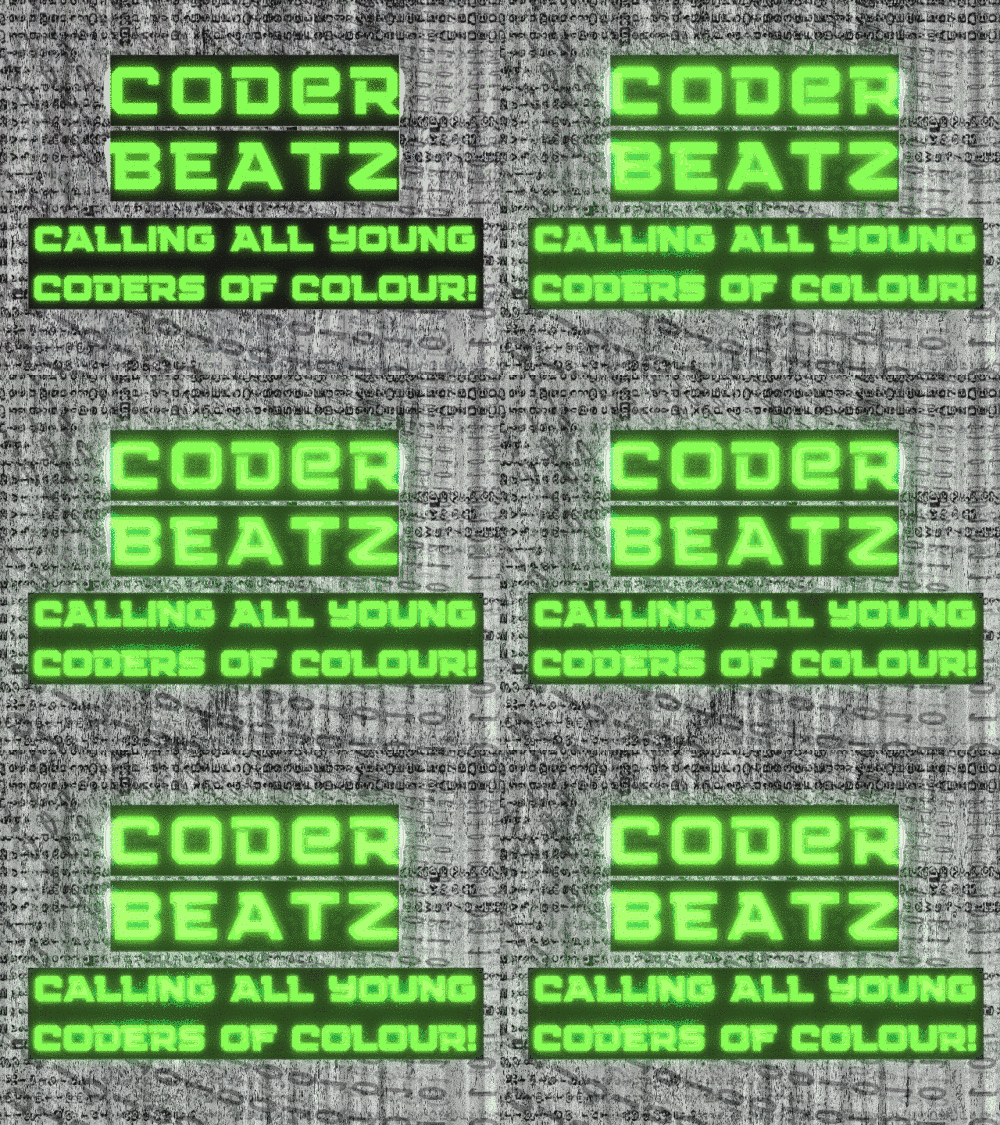
Coder Beatz a new creative digital programme for young black kids aged between 11-15 years old. We are running 4 monthly Coder Beatz workshops between November 2020 and February 2021. In each session we will be teaching kids how to create digital music and visuals using live coding and algorithms. The sessions will be delivered by Antonio Roberts who is a renowned digital artist and expert coder. Being a man of colour, Antonio is really passionate about inspiring young black kids to get skilled up on coding music and visuals.
On Saturday July 25th I’ll be delivering an online a Blender workshop for Access Space!
The three-hour workshop (13:00 - 16:00) will go through a few basics of using Blender but will mainly focus on making abstract glitchy looping gifs, like the ones that I made for Improviz.
In the fourth workshop of our Life Rewired inspired Design Yourself project, the Young Creatives worked with Yoke Collective in a workshop focused on the implications of facial recognition technology.
The group used Yoke Collective’s method of harnessing make up and hair extensions to avoid detection from facial recognition technologies. Combined with the creation of digital masks via SPARK AR as the cornerstone for our video, they explored the dynamics of power and privacy in the digital age. As a response to the workshop, artists Pietro Bardini and Vangelis Trichias worked with Antonio Roberts to create Evasive Techniques.
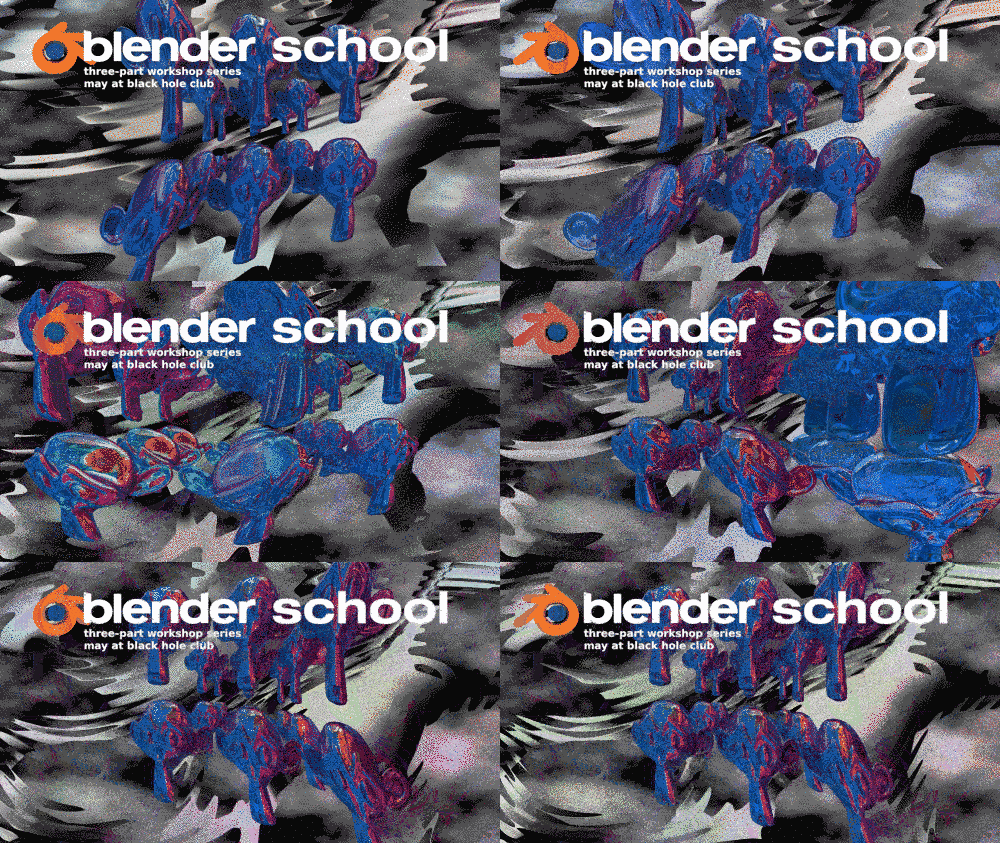
On 12th, 26th and 29th May I’m going to be running a three-part workshops series focusing on how to use Blender.
Blender is a popular free and open source 3D modeling program used by professionals and amateurs for 2D/3D animation, making assets for games, video editing, motion graphics, compositing and more.
Blender school will be a three-part workshop series that will act as an introduction to the software and its features. In these workshops you will be introduced to basic concepts of animation and navigating 3D space, eventually progressing to more advanced concepts and techniques such as particle generators, sculpting and compositing.
Join us for local food and drinks from Southside and get hands-on making with a bunch of like-minded folks interested in art and tech. This new monthly event aims to inspire emerging creatives and offer peer-to-peer tech support in a friendly, collaborative environment. Each workshop is different, featuring a different guest speaker and activities.
On 10th September I’ll be delivering a Pure Data for Beginners workshop as part of #ArtistsCompute2016 in Coventry.
Having recognised that computers have changed society beyond measure #ArtistsCompute2016 is dedicated to mapping, presenting, probing and escalating this impact.
The festival, which is built around a large group exhibition of the same name, features many educational, participatory and enjoyable events including workshops, talks, screenings, performances and parties.
The Office for Art, Design and Technology (led by Ryan Hughes) is delivering its Camouflage Season as a part of Leamington Spa Art Gallery and Museum’s exhibition, Concealment and Deception and as a part of Leamington Camouflage Festival. For its Coding Camo Workshop on the 17th August I’ll be delivering a Pure Data workshop at the headquarters of Office for Art, Design and Technology at Eaton House, Coventry.
This workshop will teach basic computer code using Processing, Pure Data and Live Code Lab and will result in a collaborative performance. The workshop will be led by Ryan Hughes and participants will benefit from 2 days working with established visiting practitioners, Antonio Roberts and Ashley James Brown. The final day of the workshop will focus on collaboratively composing a new work for performance which explores what camouflage might look like in the age of big data, ubiquitous wi-fi and so called smart devices.
Part 1: Saturday 14 May, 10am–5pm. Venue: Eastside Projects
Led by Tim Milward of backface, a 3D scanning and printing company based in Digbeth, this practical workshop will introduce you to Photogrammetry a 3D scanning process that combines multiple photographic images to create high resolution textured digital ‘objects’ which can be 3D printed or used in digital contexts.
With the closing of my solo exhibition at Birmingham Open Media fast approaching, on 19th January I’ll be holding the final workshop. In the Remix Animation Workshop we’ll explore the art of remixing and reappropriation!
In this workshop I will introduce open source software programs and discuss ideas around free culture. You will then have time to rework images downloaded from the Copy Bombs and from the University of Birmingham’s archives. Participants need to bring their laptops with the following free and open source software installed:
From 16th March to 27th April I ran a four part Pure Data Patching Circle at Birmingham Open Media. It was originally intended to be an informal gathering of Pure Data and “creative coding” enthusiasts but quickly it turned into a course in using Pure Data. Here’s some of what I learnt from running it.
This was an almost exact replication of the beginner’s Pure Data workshops that I’ve done in the past at places such as GLI.TC/H 2012, Vivid Projects and Flip Festival. I first introduced some of the projects that I have done and then dove straight into things like installing the software on different platforms.
A new ‘Patching Circle’ on creative code designed and run by artists, for artists. A Patching Circle is an informal gathering of anyone who is interested in patching languages such as Pure Data, Max/MSP, vvvv, and Quartz Composer.
As well as covering the basics of Pure Data, we’ll also offer peer-to-peer support for more experienced users and help with specific projects.
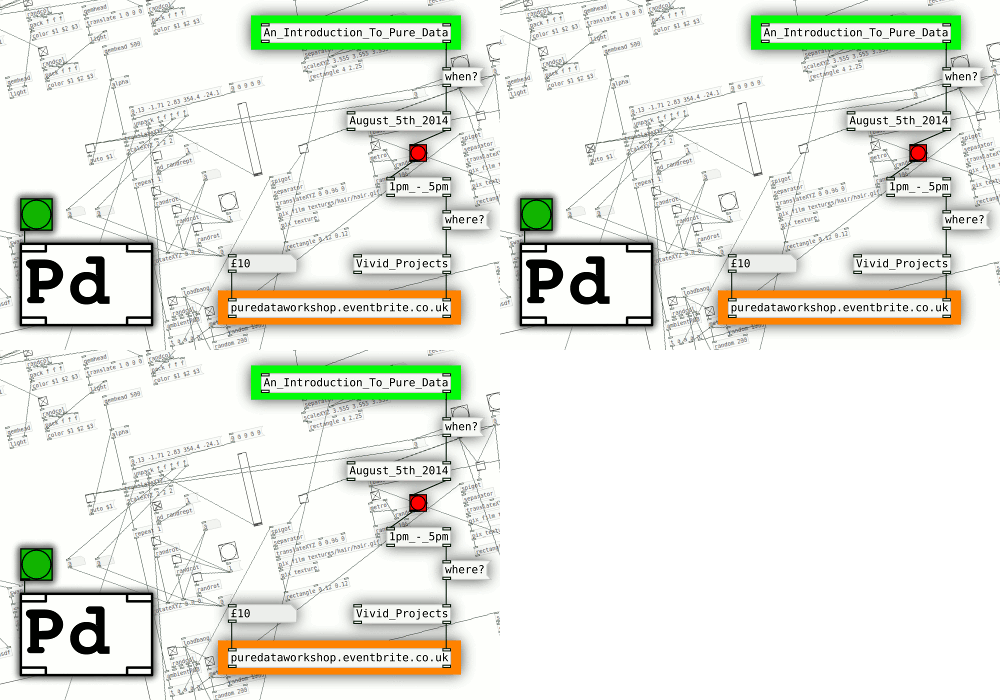
On August 5th from 13:00-17:00 I’ll be running a Pure Data workshop at Vivid Projects.
Pure Data (aka Pd) is an open source a Visual Programming Language, similar to the likes of vvvv and Max/MSP. Pd enables musicians, visual artists, performers, researchers, and developers to create software graphically, without writing lines of code. Pd has seen various implementations including live visuals (VJing), electronic music and even as an embedded library on websites, games or a Raspberry Pi.
An optical theremin is a motion-operated instrument, based on an LM386 op-amp chip, we’ll be building them from scratch, learning the basic principles behind audio manipulation using voltage, and making some unholy racket! No soldering experience necessary.
Thank you to everyone that attended the Pure Data Play workshop on 2nd November as part of Flip Festival. In the space of two hours the participants went from knowing nothing about Pure Data to manipulating 3D objects on screen, playing videos and webcam streams and controlling their videos using user-defined keyboard shortcuts. Some images of the patches: [caption id="" align=“alignnone” width=“500”] Patch by Alex Jolliffe[/caption] [caption id="" align=“alignnone” width=“500”] Patch by Eliza Marcu[/caption] [caption id="" align=“alignnone” width=“500”] Patch by Jamie Boulton[/caption]
Pure Data is a dataflow programming language that is utilised for a wide variety of purposes including making generative electronic music, creating glitch visuals, interactive live performance and VJing (Video Jockeying). I’ll guide participants through the basics of Pure Data - including general usage, playing and manipulating videos and creating generative visuals that respond to different inputs. No experience of Pure Data is necessary, only a laptop and a willingness to experiment and learn!
For the last month or so the fizzPOP team and Mr Underwood have been planning the awesomely awesome Theremin Day that took place at fizzPOP on Saturday 24th April.
The day kicked off with an optical theremin building workshop, which produced some very interesting sounds. One person described the noises produced as “lil creatures… being tortured by having light shone on them”. Decide for yourself: [audio mp3=“http://www.hellocatfood.com/wp-content/uploads/2010/04/theremin_noises.mp3”][/audio]
The circuitry for all of the theremin were the same, but the housing for the device made them all that more interesting. I think Julia’sApple Theremin wins some kind of award for most healthy looking theremin! More photos from the day:
Last week myself and others were invited to talk to someone from Ofsted about the Flying Start course. For those who don’t already know what it is, here’s the blurb:
An accredited training scheme for artists – working in any art form – who want to gain workshop planning and delivery skills and experience of community arts and participatory arts work.
The inspector was very clear to note that whilst she was from Ofested that this wasn’t actually an inspection. In the five years the course had been running it was identified as an example of good practice* and she was here to get feedback for their website from people who were on the course.
Here’s a image from a workshop I delivered as part of a group on the topic of Culture in relation to Birmingham. It was a big project, so we decided to collaborate online, which proved very useful!
Flying Start is now over and, due to a lack of funding, looks like it will completely end after five years :( It’s a real shame that funding has affected what is quite an essential course for budding community artists. The only other one I’ve seen is one at Staffordshire University but, unlike Flying Start, you have to pay for it.